










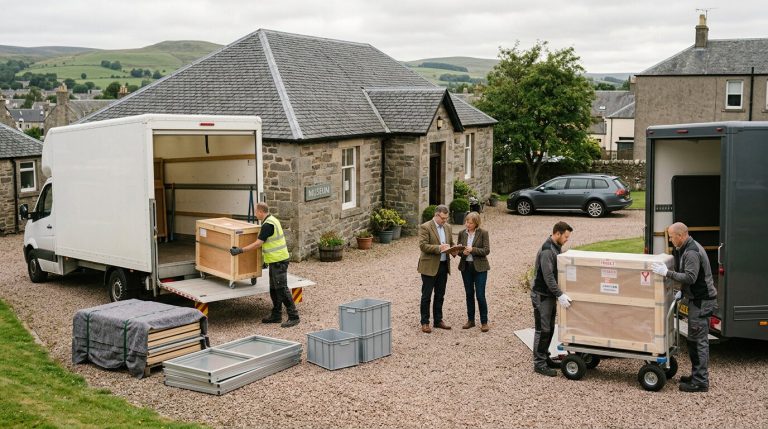
For a local history society, a heritage trust or a volunteer-run museum, a small exhibition that has done well at home often gets invited elsewhere. A library in another region, a community museum, a festival venue. When the invitation comes from Scotland and the show was built in the south of England, the logistics stop being a matter of loading the estate car.
The most useful thing you can do early is split the exhibition into three kinds of cargo: display equipment, objects of value, and people. They travel differently, they carry different risks, and they need different vehicles. This guide works through a hypothetical tour to show how.
A hypothetical touring brief
Imagine a modest local-history exhibition: twelve printed panels on folding frames, four lockable display cases, a touchscreen and speaker unit, and around thirty objects. Most of the objects are replicas or low-value items from the organisers’ own collection. Six are originals on loan from a private lender and a museum.
The show has been invited to two Scottish venues: one in West Dunbartonshire and one on the Fife coast. Two members of staff will install and take down at each, and one will stay for the opening week to run talks.
None of this is a real tour. It is a structure to plan against.
Step 1: Separate what can travel together
The touring-logistics guidance presented to ICOM UK sets out clear roles: the originating venue documents the content and arranges packing, while receiving venues provide storage and access information and liaise over deliveries (The Logistics of Touring Exhibitions, ICOM UK, PDF). It also stresses knowing “intimately the needs of the objects you are touring”. That starts with sorting.
| Category | Hypothetical items | How it might travel | Who decides | Questions to settle |
|---|---|---|---|---|
| Display equipment | Panels and frames, empty cases, AV unit, tools, signage | Hired van, packed and driven by staff | Organisers | Load length and payload; venue loading access; who drives |
| Objects of value and loans | Six original loaned objects | As the lender’s loan agreement and insurer require; often a specialist fine-art carrier, sometimes with a courier | Lender and insurer, not the organisers | Crating, environmental needs, condition reports, transit insurance |
| Low-value objects | Replicas and handling items | Packed in labelled crates with the display equipment, if the organisers’ insurer agrees | Organisers and their insurer | Is transit cover in place? Who checks condition on arrival? |
| Staff travel | Two installers, one talks host | Train or car between venues; a car for local journeys | Organisers | Named drivers, licence checks, parking at each venue |
Step 2: Hand the specialist handling to specialists
Loaned originals are the one part of the plan not to improvise. Lenders often set conditions for packing, transport, storage and security, and those conditions decide the vehicle. If the loan agreement or insurance names a carrier type, follow it exactly. Ask the lender early, because fine-art transport has lead times, and it may shape the dates the venues can offer.
Keep the van and the valuable objects on separate lines of your plan, even if a specialist later says some items can share a vehicle.
Step 3: The display-equipment van
Panels, frames and empty cases are bulky but robust. A hired van, loaded by people who know how the show fits together, is often the practical choice. For the West Dunbartonshire leg, the Dumbarton van hire enquiry page lists vehicles from small panel vans to Luton and tail-lift types. Before booking, confirm the exact vehicle’s internal load length against your longest frame, its payload against the total weight of cases and crates, and whether a tail lift is fitted.
Check the driver’s licence too. A standard category B licence covers vehicles up to 3,500kg maximum authorised mass for petrol and diesel, according to GOV.UK. Many Luton vans sit at that limit, so check the plated weight.
Step 4: Staff travel in Fife
The second venue is on the Fife coast. Staff might arrive by train and need a car for the week: to reach the venue early for installation, to carry a toolbox and spare lamps, and to get back after evening talks. If that applies, you can enquire about car hire in Leven, where the page lists cars alongside other vehicle types for the area. Ask about delivery to accommodation or a station, named additional drivers, and insurance excess.
The car is for people and small kit. Display equipment stays with the van, and loaned objects stay with whoever the lender has approved.
Step 5: Verify venues and access
Every receiving venue should answer the same questions before anything moves:
- Where does a van park to unload, and for how long?
- Is there step-free access, a lift, and doors wide enough for your largest case?
- Is there secure storage overnight for empty crates?
- What are the environmental conditions in the display space, if any loaned object needs them?
- Who signs for deliveries, and who has keys on installation day?
A tour-planning worksheet
Fill one in for each leg.
- Leg: from ________ to ________, dates ________
- Display equipment: vehicle ________, driver ________, load length needed ________ m, weight ________ kg
- Objects of value: carrier ________, approved by lender? Y / N, courier required? Y / N
- Low-value objects: crate count ________, transit cover confirmed? Y / N
- Staff travel: people ________, mode ________, local car needed? Y / N
- Venue: unloading point ________, contact ________, storage for crates? Y / N
- Return or onward move: date ________, same vehicles? Y / N
Splitting the cargo early makes the rest of the plan simpler. The van booking, the car booking and the lender’s conditions each become a short, separate conversation, and none of them has to stretch to cover the others.